The Real Lone Ranger?

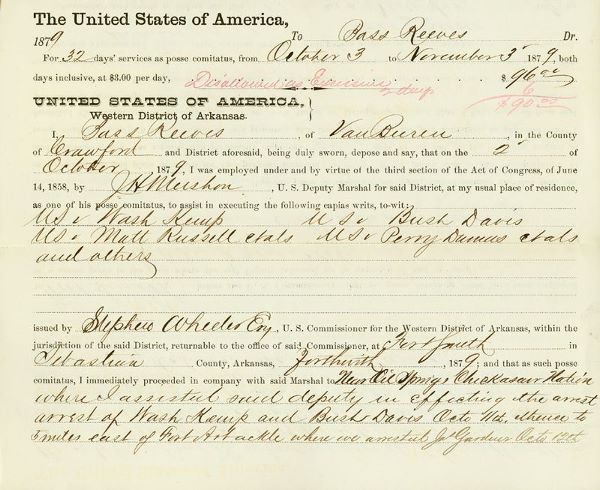
Here at The Storage Inn in Egg Harbor Township New Jersey, most of our storage units are filled with things like beds, refrigerators, boxes, and totes, but every once in awhile we hear about something very interesting being found inside one of our storage spaces. This past weekend the family of one of our longtime self storage customers began going through the items in a unit that belonged to their grandfather. “Grandad” had passed away some time ago, and they were just getting around to sorting through the contents. About midway through the day, I stopped by the storage unit to see how they were making out. I spoke to the man’s granddaughter, Peggy, who showed me a large envelope that appeared to be quite old.  Written on the outside of the envelope were the words “ The Real Lone Ranger”.  Inside was a picture of a man, and a document signed by someone named Bass Reeves. They both appeared to be from the Civil War era, but neither of us knew who Bass Reeves was, so we did what any red-blooded American would do, and asked Google!

Here is what we discovered….

Contrary to what classic westerns might have us believe, one in four American cowboys was actually African-American. It turns out that the true inspiration behind The Lone Ranger (and possibly Django from Django Unchained) may have been real life US Deputy Marshal Bass Reeves, an African-American who fled the Civil War, befriended the Seminole and Creek Indians, and eventually became one of the greatest lawmen of the Wild West.

Bass Reeves was born a slave in 1838. When the Civil War broke out, Reeves went into battle with his master and fought for the Confederacy. It was during the Civil War that Reeves made his great escape from slavery. Reeves took refuge with the Creek and Seminole Indians. He learned their languages and customs, and sharpened his skills as an ambidextrous marksman. During the chaos of the Civil War, Indian Territory became the hiding grounds for outlaws. In 1875, U.S. Marshal James F. Fagan was ordered to lead 200 deputies in the pursuit of these outlaws. The stories of Reeves’ familiarity with the land and his own fugitive past got around to Fagan, and Reeves was soon hired on as a U.S. Deputy Marshal. Reeves, along with the other deputies, was ordered to bring the outlaws back  — dead or alive.

Reeves took his job as a marshal very seriously. Six feet, two inches tall, the slender Reeves rode a large white stallion as he patrolled all 75,000 square miles of Indian Territory. The rough and tough lawman, with his intimidating black hat, two colt .45 Peacemakers strapped at his sides, slick suits, and polished shoes, brought over 3,000 felons to justice – far more than Wyatt Earp or Bill Hickok.

By all accounts, Reeves was also a master of disguise. He would appear to felons as a cowboy, farmer, or even an outlaw (wearing a mask).
And when he wasn’t in disguise, he was easily recognized by the silver dollars he left as his calling card. Reeves was also known to have traveled with a native American who helped him track outlaws.

Despite disguises and calling cards, Reeves treated his position with great respect. Even in the face of morally conflicting circumstances, Reeves held the law above all – He once arrested and jailed his own Son for murder.

In 1907, law enforcement was put in the hands of state agencies and Reeves, now nearly 70, joined the Muskogee Oklahoma Police Department as a patrolman. However, shortly after, on January 12, 1910, Bass Reeves passed away due to Bright’s disease.

There you have it – the story of a man who many consider to be the inspiration for the fictional character The Lone Ranger. I don’t know if the picture or the document are worth anything, but it sure made for an interesting day at The Storage Inn. Well, I gotta go – it’s time for me to ride off into the sunset – now if I only had a horse!

Tips for keeping your pet safe and cool this summer.

6 Ways To Protect Your Dog From Summer Heat

The July heat is on here at The Storage Inn of Egg Harbor Township New Jersey, but it doesn’t seem to slow down our self storage tenants. They just keep motoring to and from their storage spaces like the Energizer Bunny, stopping into our rental office every once in awhile for a complimentary bottle of ice cold spring water.

Today I had a visit from one of our tenants, Sergeant DiPiano – he’s a K-9 Officer, and always has his dog, Trooper, in the back of his vehicle. I asked him how Trooper handles the heat.

“No problem “ he answered “ He loves the AC! “ – “I do end up rescuing a couple of dogs from cars each summer”, he added. “I just wish people would realize how dangerous the heat is for their dogs!”.

Right about then he said he had something for me and headed out to his cruiser. He came back and handed me a stack of pamphlets entitled “6 Ways To Protect Your Dog From Summer Heat”.

Here are those tips courtesy of Sergeant DiPiano.

1. When the temperature is high, don’t let your dog linger on hot surfaces like asphalt and cement. Being so close to the ground can heat their body quickly and is also an invitation to burns on sensitive paw pads. Keep walks to a minimum.

2. Giving your dog a lightweight summer haircut can help prevent overheating, but never shave to the skin. Dogs need one inch of protection to avoid getting sunburned.

3. Provide access to fresh water 
at all times. Make certain an outside dog has access to shade and plenty of cool water.

4. Restrict exercise when temperatures soar, and do not muzzle the dog because it inhibits their ability to pant.

5. Many dogs enjoy a swim, splashing in a wading pool, or a run through a sprinkler in warmer weather which can help bring body temperatures down.

6. Never leave your pet in a parked car! Not even if you park in the shade or plan to be gone for only a few minutes. The temperature inside of a car can reach oven-like temperatures in just minutes, often in excess of 140 degrees. That quick errand can turn into a disaster and could be fatal for your pet.

Any pet that cannot cool himself off is at risk for heat stroke, but some breeds and dogs with certain conditions are more susceptible. Heart disease, obesity, older age, or breathing problems put the dog at higher risk, and for these animals even normal activities in intense heat can be harmful. Dogs with shorter snouts – like Pugs or Bulldogs – have a harder time panting out their body heat, and certain breeds don’t tolerate the heat as well as others. This group includes English and French Bulldogs, Boxers, the Saint Bernard, Pugs, and Shih Tzu.

Well, there you have it folks, some great tips for keeping your pup cool in the summer; and if you bring your four legged friend with you to The Storage Inn, be sure to stop into the rental office for some ice cold spring water for both of you! Have a cool and happy summer!

Happy Summer Everyone!

Summer Fun Facts from The Storage Inn

Summer is officially here in Egg Harbor Township and The Storage Inn is bustling with warm weather activity. Landscape storage customers are shooting in and out, retrieving items from their storage spaces. Families are grabbing barbecue grills, surfboards, and bicycles from their summer storage rentals, and I even saw one of our younger self storage tenants on roller blades!

Everybody loves summer! To celebrate, I’d like to share a few interesting facts about summer with our readers.


In the United States, the top 5 most popular summer vacations are

1) beach/ocean (45%),

2) a famous city (42%),

3) national parks (21%),

4) a lake (17%), and

5) a resort (14%)


The “dog days of summer” refer to the weeks between July 3 and August 11 and are named after the Dog Star (Sirius) in the Canis Major constellation. The ancient Greeks blamed Sirius for the hot temperatures, drought, discomfort, and sickness that occurred during the summer.


In the summer heat, the iron in France’s Eiffel Tower expands, making the tower grow more than 6 inches.


The month of June was named after  Juno, the wife of Jupiter. July is named after Julius Caesar, and August after Caesar Augustus.


The first Olympic Games in the modern era were the 1896 Summer Olympics, officially known as the Games of the Olympiad in Athens, Greece. The Games featured the Panathinaiko Stadium, the first giant stadium of the modern world that housed the largest crowd to ever watch a sporting event.


Watermelon, a summer time favorite, is part of the cucumber, pumpkin, and squash family and consists of 92% water. On average, Americans consume 15 pounds of watermelon annually.


The popsicle, another summer time treat, was accidentally invented by an 11-year-old boy in San Francisco in 1905 during the cooler part of the year. He left a glass of soda sitting outside and by the next morning it had frozen solid. A little time later in life he began selling them at an amusement park in New Jersey. Cherry is the number 1 popsicle flavor in the United States.


Before the Civil War, schools did not have summer vacation. In rural communities, kids had school off during the spring planting and fall harvest while urban schools were essentially year-round. The long summer holiday didn’t come about until the early 20th century


The record for the most people applying sunscreen was on January 8, 2012, in Australia with 1,006 participants applying sunscreen for 2 minutes.


There you have it – A few things that you may not have known about Summer! Happy Summer everyone from all of us here at The Storage Inn!

The Heat is on!

Its mid June and the temperatures at The Storage Inn in Egg Harbor Township New Jersey, and The Storage Inn of Ocean City are starting to soar! The heat and humidity, however, does not seem to deter our customers from shuttling in and out as they rearrange and retrieve items from their storage spaces.

As a courtesy to our self storage customers, we keep a refrigerator stocked with cold water to help them stay cool. Working in high heat and humidity can be dangerous, especially for our senior tenants, so each year we offer a few extra tips on avoiding heat-related problems while working outdoors.  

Here are this year’s tips…

1. GRUNT WORK FIRST

Minimize your own energy loss by doing the heavy lifting early, so you can spend the hot hours in the shade, slowly patting yourself on the back.

2. BUCKET COMFORT STATION

Put an empty bucket in the shade and fill it with icy water to keep your drinks cool, your washcloths wet and your cold packs charged, or to give yourself a reason to kick off the work boots for an invigorating foot-bath. Just don’t drink out of it!

3. GET MISTY

Using the garden hose to give yourself a spritz to the back of the head on the “mist” setting gives a relieving rinse, while a little jet action to bare feet cools you off and freshens you up. The more settings you have, the more satisfying the shower.

4. SAVE THE ALCOHOL FOR LATER

Alcohol is a diuretic, which dehydrates you by causing the body to lose more water than it absorbs. Save it for the shade!

5. SHIELD YOUR SKIN

Wear loose-fitting, lightweight, porous clothing. Choose heat-reflecting light-colored fabrics rather than absorbent dark ones, using long sleeves and pants to shade your skin, absorb sweat and reduce your surface temperature.

6. COOL TRICKS

Squeeze ice wrapped in wet washcloths behind your knees, on your wrists, in your armpits or on any major arterial lines. In the South, Little League team moms keep cloths in coolers for kids to wring around their necks between innings. In the yard, you can get creative. Chinese medicine cites the wrists as key to clearing the body’s heat.

7. KEEP A COOL HEAD

“Approximately 20 percent of your blood supply flows to your face,” says Walter Herman, M.D., a retired cardiologist from Philadelphia’s Jefferson Hospital. So you can lower the heat to the rest of your body if you just keep a cool head. If you can’t move your work to the shade, create your own with a broad-brimmed, light-colored hat. A bandana soaked in the ice bucket, or a sombrero left over from Cinco de Mayo would also do the trick.

8. EASY BREEZY

Use a work fan or a garage fan to keep the air moving over you. Fans create wind chill (a term more often used on frigid days). In this case, the sensation of coolness comes from sweat evaporating from your skin more quickly than in still air. You may also fan yourself with any of the hats from tip #7.

9. COOL VEST!

For working in severe heat, you may want to consider a cooling vest. The Cool Vest costs about $130 to $200 and uses chemical cold packs that are inserted into pockets in the vest. After a few hours of exposure, drop them in the ice bucket for a recharge.

10. DRINK HEAVILY

Last on the list, but first in importance: Stay hydrated.

The US Army Field Manual warns that you can’t use your own sense of thirst as a guide. Thirst occurs late in the dehydration process, in many cases hours after you’ve become dehydrated. If you don’t feel the need to urinate hourly, and if your urine has turned from a healthy lemonade color to a jaundiced maize, you’re probably already dehydrated. Stop working and take a swig of water, sipping frequently in small amounts rather than the occasional guzzle.

Add a little lemon, mint or cucumber to a cool glass of water for hydration with a twist. Or munch on watermelon, which is 92 percent water, according to the National Watermelon Promotion Board.

As for all that beer you’ve been keeping cold? Pop one open after a cool shower and dinner.

There you have it folks! Plenty of great tips on staying cool for the summer. 


June is National Safety Month

June is Here – Be Safe Out There!

June is finally here, and Summer is right around the corner – the staff here at The Storage Inn Self Storage in Egg Harbor Township New Jersey couldn’t be happier! It’s great to watch our customers going to and from their storage units with big smiles on their faces, in shorts and flip-flops, driving jeeps and convertibles,on a mission to retrieve their summer items from their storage spaces. One of our tenants, Mr Care, stopped in today to get some packing supplies, but also to remind us that June is National Safety Month. Bill works for the National Safety Council. He left me a pamphlet on National Safety Month, so I read it, and here is what I learned…

Each June, the National Safety Council and its partners raise community awareness on preventing the leading causes of injury and death at work. Each week of June has a different focus area. Listed below are the four focus areas and some info on each.

Week 1: Emergency Responders

The nation depends on emergency responders to preserve the public’s safety and health when
disasters strike. To successfully meet this challenge, emergency responders must be protected from the hazardous conditions that disasters and other emergencies create, whether they be natural or as a result of human action.

Week 2: Be Healthy

Healthy people are statistically less likely to be injured, whether it’s at the workplace or in the home.The keys to staying healthy are diet, exercise, and regular medical check-ups.

Week 3: Watch Out for Danger

While safety is important in all aspects of our lives, ensuring safe workplaces has the potential to save thousands of lives and prevent tens of thousands of injuries and illnesses each year. In 2014, 4,821 U.S. workers died from work-related injuries and approximately 3.7 million workers suffered non-fatal injuries and illnesses.

Home safety is also very important. Follow all safety guidelines when using appliances, power tools, and yard equipment. Be sure to keep all household cleaners, chemicals,  and prescription and non-prescription medications in a safe place, Be aware and be safe!

Week 4: Share Roads Safely

Distracted driving occurs any time you take your eyes off the road, hands off the wheel, and mind off your primary task: driving safely. Communication systems in vehicles are there for convenience, not safety. Even hands-free devices pose a threat because the brain remains distracted.

Last but not least, do not engage anyone who appears to be having a bout with road rage. Remain calm, pull off safely, and let them pass.

Okay, So there you have it – The four focus areas of National Safety Month! The team here at The Storage Inn wishes everyone a great Summer. Be safe out there!

You have a bee to thank for one in every three bites of food you eat!!

Yesterday was a particularly warm Spring day here at the Storage Inn in Egg Harbor Township New Jersey. One of our self storage customers, Victor, stopped in to buy some boxes, when we noticed another tiny visitor in the office  – a bee !  Mr. Bee bounced off the glass of the front windows trying to make his escape back to the outdoors. My first inclination was to grab the office fly swatter, but Victor stopped me… “You can’t kill him! Don’t you know that bees are now an endangered species?” Victor opened the front door and was able to get Mr. Bee to freedom, eliminating the chance of storage rental customers getting stung. Victor followed Mr Bee, flying out the door to his storage unit, so I decided to check out his claim that bees were an endangered species.

What I discovered is that several American bee species have been classified as endangered. Scientists know that bees are dying from a variety of factors – pesticides, drought, habitat destruction, nutrition deficit, air pollution, global warming and more. So, why do we need bees?

Here are some reasons…

More than $15 billion a year in U.S. crops are pollinated by bees, including apples, berries, cantaloupes, cucumbers, alfalfa, and almonds.

U.S. honey bees also produce about $150 million in honey annually. But fewer bees means the economy takes a hit.

The global economic cost of bee decline, including lower crop yields and increased production costs, has been estimated at as high as $5.7 billion per year.

Keeping bee populations safe is critical for keeping American tables stocked with high-quality produce and our agriculture sector running smoothly.

As you can see, humans are dependent on honey bees for a large portion of their dietary needs. So just remember these facts as you enjoy your summer barbecue and watch out for Mr Bee circling your soft drink. Be careful not to swat him too hard – you could be committing a federal crime by swatting an endangered species!

Spring Cleaning!

Spring Cleaning Tips For Your Storage Spaces!

Storage Sheds and a Good Spring Cleaning

Spring has sprung and the grass is growin’. Time for spring cleanin’ and a little yard mowin’!

That’s right folks, the spring weather has certainly arrived and everyone and everything is gettin’ busy doin’ it’s thing, including the grass! Yep, it’s time to pull out the mower and get’er going. But, when many of us open the door to the storage garage sometimes it’s not quite so easy to do. The mower is in there somewhere, but it’s gonna take some time to find it! Instead of pushing this and that out of the way. Get organized. Take a little time to give the shed a good spring cleaning. Let’s face it, you have a lot of weeks ahead that you’ll be needing easy access to this storage space. So put some of that spring zing and pep in your step to good use; let’s give the storage shed a good spring cleaning.

Everything out!
If you’ve got a mess, pull it all out. Sort your items into piles of like items. Set aside any items that you no longer need and decide if they are trash or yard sale merchandise! Now if an item doesn’t belong in the storage shed, simply decide where it needs to be and put it back in it’s rightful home.

Self Storage Solutions

Clean Up Time
Time to sweep the floor and wipe down the shelves and work bench areas. You may also want to inspect the items that you’re storing to see if they need to be wiped off or hosed down before returning them to the shed. A clean and neat storage space will make your gardening and yard work life so much more enjoyable and easy to do!

Re-group and Replace
Now that everything’s out, and your space is clean, it’s time to reorganize and place your items back into the shed. Store the items that will be used most often toward the front of the storage space. Items that get used less frequently can be stored further back. Leave yourself a path to reach all of your warm weather items when needed. Hanging tools on walls or pegboard, as well as keeping smaller items in cans or plastic containers can also free up additional storage space. If you find yourself still in need of more storage space for items, such as your autumn fire pit or those Christmas decorations that you finally found, you may want to consider a small self-storage space. Your local self-storage facility will be happy to assist!

Now that you’ve put everything back into your clean storage space, you can stand back and admire your great work. Organized and ready, it’s time to enjoy all that fun lawn mowing, weed whacking, weed pulling, painting, gutter cleaning, hedge trimming, and the list goes on and on and on…. and oh well, hopefully you’ll get to use those sparkling bicycles and tidy beach chairs once or twice before winter returns!

LIttle League Baseball History

The Storage Inn talks with a youth sports storage rental customer about the origins of Little League Baseball.

Little League Baseball Storage and The Story of Carl Stotz

So winter is over, and nothing says Spring quite like the crack of a baseball bat, or the sound of a ball hitting a glove! Here at The Storage Inn self storage in Egg Harbor Township New Jersey, we get a visit every spring by our local Little League team to retrieve their baseball gear from the two storage units they rent. Coach Friedman stopped into the storage rental office to say hello, and we got to talking about the origin of little league baseball.

”I know the story of Abner Doubleday, and his inventing the game of baseball, but do know how little league baseball came about?” I asked coach Friedman. “Just so happens that I have a pamphlet in my truck that we hand out to the parents of our kids when they sign up for Little League – I’ll grab you one” said the coach.  I read up on the subject between storage rentals and here is what I learned about the history of little league baseball.

Carl E. Stotz, was a Williamsport Pennsylvania lumberyard clerk who came up with the idea for Little League baseball when he stumbled over a lilac bush during a backyard game of catch with his two young nephews in 1938.
Mr. Stotz, a lifelong Williamsport resident who later served as tax collector there, never tired of describing the summertime mishap that launched the vast Little League game now played by more than 2.5 million youngsters in more than 30 countries. As he frequently recalled, “I banged my leg against a bush, and while I sat on the back steps letting the pain subside, I asked my nephews… How would you like to play on a regular team with uniforms, your own cap, a new ball for every game and bats your size?!”

A few weeks later he crammed most of the neighborhood into his 1934 Plymouth and set out in search of the perfect field. By the end of the summer he had devised the stripped-down, boys’-sized dimensions at the core of Little League’s eventual spectacular success: 60 feet between the bases (two-thirds of the major league distance) and 46 feet from the pitcher’s mound to home plate (instead of 60 feet 6 inches).

By the next summer, Mr. Stotz had recruited sponsors for three teams, and on June 6, 1939, on a field he laid out himself, Lundy Lumber beat Lycoming Dairy, 23-8, and Little League baseball was born.

The league expanded and quickly spread across the country. There was a Pennsylvania state tournament in 1947, and two years later a national championship when the first Little League World Series was held.

Carl Stotz even established his own museum in a converted toolshed behind his house. In a place of honor among the other original Little League memorabilia he installed a glass case containing the very lilac bush that gave the game its start.

To this day, The Little League World Series is played in Williamsport Pennsylvania, drawing thousands of visitors to the tiny Mountain town.

So dust off your gloves, grab your bat and ball, and let’s head out to the field for some baseball. I’ll have to be very careful as I prepare to leave The Storage Inn rental office for the baseball field. We have quite a few lilac bushes around here – Play Ball!


Prepping your Motorcycle for Spring
Chuck’s Checklist

Well it’s a balmy 70 degrees in February, and there are plenty of motorcycles cruising past our office at The Storage Inn Self Storage facility here in Egg Harbor Township in South Jersey. I’ve also noticed a few of our storage space customers getting their bikes out  – who could blame them on a day like this? As I was making my rounds, I came upon one of our long time motorcycle storage customers, Chuck, who had his storage unit door open, and appeared to be staring intently at the inner workings of his Harley Road King.” Headed out?” I yelled to him. “ Not until I do my Spring safety check “  he shouted back at me. Upon further investigation, I found that Chuck actually had a checklist that he follows every spring – things to check prior to getting the old two wheeler on the road for the season. Being a rider myself, I was curious to see what his list included.

Here is Chuck’s checklist…..

  1. Check your battery – This the heart of your ride’s electrical system. Chuck says that any biker worth his salt will have already been connected to a trickle charger, and should be good to go, but if you don’t have your battery on a charger, the first thing to make your motorcycle ride-ready is to charge your battery.
  2. Change the oil & filter – It’s best to change your bike’s oil before you store it for the winter, but if not, now’s the time to do it. Swap that stale lubricant for fresh clean oil and a new filter. If you don’t do the work on your bike, make arrangements with your favorite cycle shop to get it done.
  3. Kick the Tires : We don’t really want you to kick them, but you should do a full 360 degree check on each tire for any cracking or punctures. Also, check for wear. On many tires, tread wear indicator bars signal a need for replacement, but another easy check – if you can see the top of Lincoln’s head on a penny when inserted in the tire tread, Lincoln’s head facing down, it’s time for a new tire. If your tires pass the wear test, inflate them to manufacturer’s inflation specs and your rubber is ready to go!
  4. Fuel up  – Ideally, you should have stabilized the fuel in your motorcycle during the winterization process before you placed it into storage. If you didn’t winterize, and also didn’t fill the tank before storing, check the fuel tank for rust, which may have formed due to water condensation. If the tank is clean, fill it and ‘ride-on’. If there are signs of rust, you’ll live with the consequences – fouled carburetor, clogged fuel filter, etc. – until you replace the tank.
  5. Check your Connections – A Spring tune up of cables, plugs, and pivot points is time well spent. Check all electrical connections, cables, and all moving parts that might require lubrication. Things tend to dry out over the winter, so take the time to make sure that the moving parts are kept moving!
  6. Lights! Camera! Action! Turn on your motorcycle’s power and check all the lights for any that have inoperative bulbs and replace them. (i.e.  brake lights, turn signals, headlights, etc.) Often, replacement bulbs come in twos, so save extras for the next time you need one. If a new bulb does not light, it’s time to check the fuse box. If that doesn’t work, it’s time to visit your local cycle shop. electrical problems are best left to the experts.
  7. Ready, Set, Stop! Stopping your motorcycle safely is just as important as insuring your bike can accelerate. Before you hit the road, thoroughly check all the components of your brake system – lever adjustment, cables, calipers, brake pads, etc. If things don’t seem right and you’re not comfortable making adjustments, seek professional help. It’s always better to be safe than sorry.
  8. Stay Hydrated – Check all of the motorcycle’s fluid levels – brake, clutch, oil, coolant. Top them off as needed. Look for any leaks on the floor where your motorcycle’s been stored. Another way to check for leaks is to start and warm your bike up to running temperature, then turn it off and check for leaks.
  9. Keep it Clean – The old adage, “Cleanliness is next to Godliness” is true – especially for your motorcycle. When you’ve taken all the steps to prepare your motorcycle mechanically, thoroughly clean the exterior. Your bike will look as good as it runs and you’ll look good riding it!!!

So there’s Chuck’s checklist, so get ready, get that bike out of storage and get ridin’! With 70 degrees in February, you’d better do it now while it’s warm – could be snowing next week!


Happy Valentine's Day!

Happy Valentine’s Day From The Storage Inn

Lots of Cards and The Legend of Saint Valentine

It’s a cold February day here at The Storage Inn in Egg Harbor Township, New Jersey. One of our storage space tenants, Mrs Ragnoli, just stopped in to the office for some boxes and bubble wrap, but before she left, she said, “ Don’t forget to buy your wife roses – you know Tuesday is Valentine’s Day!”. “She’s right“ I thought – “ I also need to make a dinner reservation”.

Speaking of Valentine’s Day I recently read that approximately 150 million Valentine’s Day cards are exchanged annually, making Valentine’s Day the second most popular card-sending holiday after Christmas,.This made me think. “ What is this holiday really about other than roses, cards, and chocolates? And what size self storage space would hold 150 million greeting cards?”

The Man, the Myth, the Legend

I checked it out and found that the history of Saint Valentine’s Day is shrouded in mystery. Who was Saint Valentine, and how did he become associated with a holiday that celebrates love? One legend contends that Valentine was a priest who served during the third century in Rome. When Emperor Claudius II decided that single men made better soldiers than those with wives and families, he outlawed marriage for young men. Valentine, realizing the injustice of the decree, defied Claudius and continued to perform marriages for young lovers in secret. When Valentine’s actions were discovered, Claudius ordered that he be put to death.  According to one legend, an imprisoned Valentine actually sent the first “valentine” greeting himself after he fell in love with a young girl, possibly his jailer’s daughter, who visited him during his confinement. It’s alleged that he wrote her a letter signed “From your Valentine,” an expression that is still in use today.

At the end of the 5th century, Pope Gelasius declared February 14th  St. Valentine’s Day. It was not until much later, however, that the day became definitively associated with love. During the Middle Ages, it was commonly believed in France and England that February 14th was the beginning of the mating season for birds, which added to the idea that Valentine’s Day should be a day for romance.Valentine greetings were popular as far back as the Middle Ages, though written Valentine’s didn’t begin to appear until after 1400.

Love American Style

Valentine’s Day began to be popularly celebrated around the 17th century. By the middle of the 18th, it was common for friends and lovers of all social classes to exchange small tokens of affection or handwritten notes, and by 1900 printed cards began to replace written letters .

Americans probably began exchanging hand-made valentines in the early 1700s. In the 1840s, Esther A. Howland began selling the first mass-produced valentines in America. Howland, known as the “Mother of the Valentine,” made elaborate creations with real lace, ribbons and colorful pictures. Today, according to the Greeting Card Association,Valentine’s Day is the second largest card-sending holiday and women purchase approximately 85 percent of all valentines.

Storing 150 Million Valentine’s Day Cards

This is certainly an approximation because there is a wide variety of card sizes and shapes, but if a customer wanted to store 150 million cards that were 4 x 6 inches and printed on 100lb cardstock (.011 inches thickness x 2 sides) it would take about 45,833 cubic feet. To put that into perspective, we would need about 46 storage units that were 10 foot tall x 10 foot wide x 10 foot deep. That’s a lot of cards!

So there you have it – Valentine’s day is about buying cards and eating Chocolate! – Just kidding!  It’s actually about Love and Romance and Taking the Time to tell your special somebody that you care. Happy Valentines Day to All from the staff at The Storage Inn!